Rainscreen & Façade FAQs
What is a rainscreen facade?
A rainscreen (rear-ventilated) facade is a multi-layer wall with cladding fixed off the load-bearing wall, separated by insulation and a ventilated cavity. The outer cladding protects from rain, wind and sun while the cavity supports drainage and drying to safeguard the structure.
Why is the ventilated cavity important?
The cavity creates a capillary break and promotes drainage and airflow, speeding drying and moderating moisture and pressure behind the cladding. Top and bottom venting improve air exchange and overall durability of the wall assembly.
How is a rainscreen facade built, layer by layer?
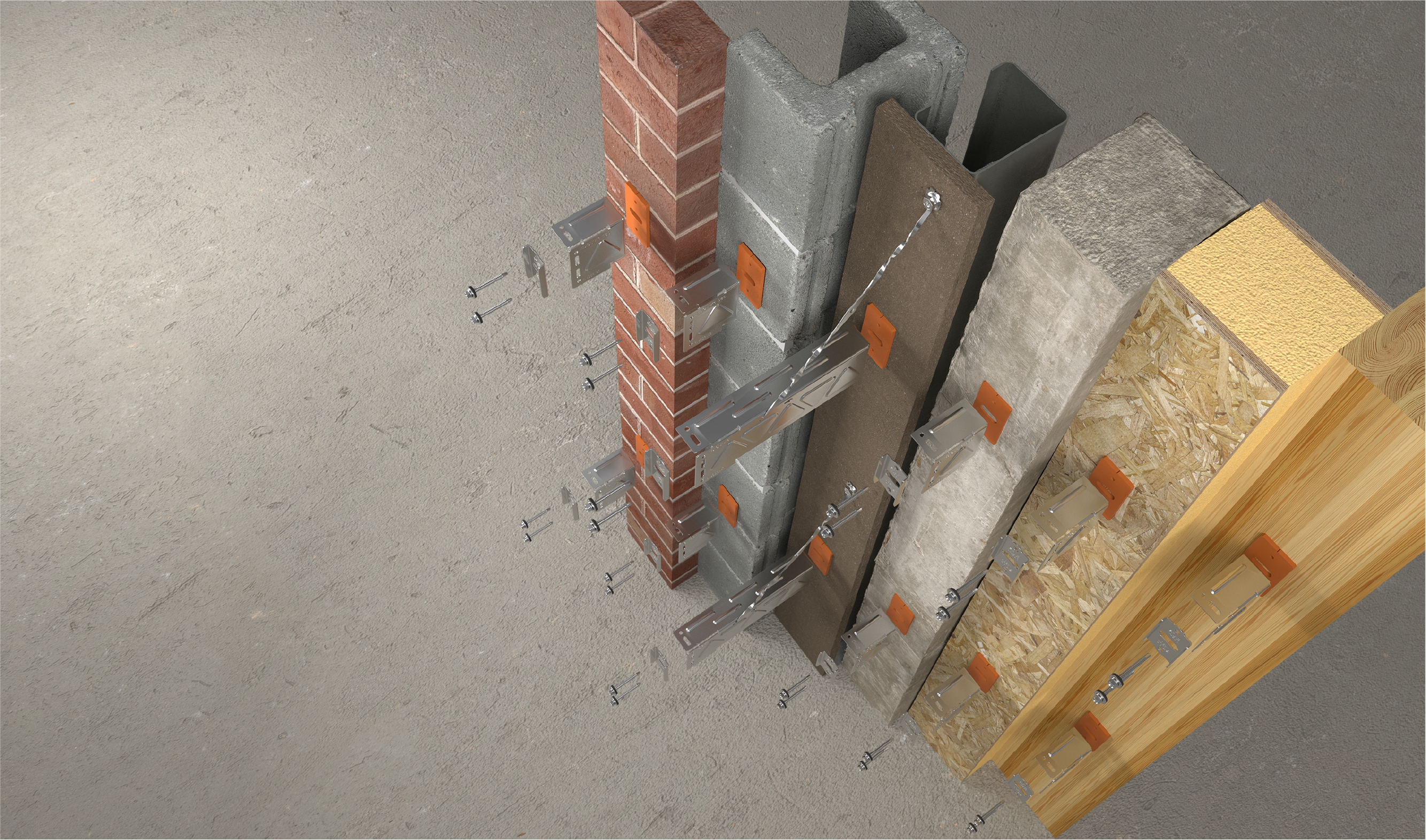
Typical layers are: substrate, thermal break at brackets, insulation fixed with anchors, support profiles (rails), and cladding, leaving a rear ventilation gap between insulation and cladding. Fixed and sliding attachment points manage movement; visible fasteners or concealed systems may be used.
What are “fixed” and “sliding” points, and why do I need both?
A fixed point carries vertical loads (e.g., panel weight). Sliding points take horizontal loads (e.g., wind) while allowing thermal expansion/contraction via slotted holes. This “unforced” installation prevents bulging, buckling and aesthetic defects over time.
How does EN 1993-1-4 affect fastener material choice?
You determine a Corrosion Resistance Factor (CRF) to assign a corrosion class (CRC). Facade connections commonly require CRC III or higher, typically stainless steel A4, to ensure durability in expected service environments. National annexes may refine selections.
What are the main embedment mechanisms for fixings?
Three principles: frictional (expansion) anchors that develop pull-out via sleeve pressure; guided connections (e.g., undercuts) with low expansion pressure and high safety in cracked substrates; and adhesive bonds using injection mortars for solid materials, enabling low edge distances.
When should I choose single vs multiple fastening?
Multiple fastening distributes loads across at least three structurally linked points, so a single-point failure doesn’t cause collapse, only visible deflection until secured. Where multiple fastenings aren’t feasible (e.g., corners, lintels), approved single-point solutions (e.g., through bolts or injection anchors) are used.
What makes through bolts reliable, and what can go wrong?
Through bolts are torque-controlled; under-torque risks slip/sag, over-torque risks substrate cracking or anchor fracture. They can achieve high capacity in cracked concrete and seismic cases but require correct edge distances and embedment per design software/guidelines.
When are injection systems preferred?
Use injection systems when other anchors can’t meet loads, or for thin-walled perforated bricks. Matched mortars, mesh sleeves and stainless or galvanised rods create high-capacity adhesive bonds and control mortar flow in perforated units.
How do I select and install plastic facade anchors correctly?
Follow ETA key values for substrate, hole diameter, embedment depth and spacing. Use push-through installation (per EAD 330284-00-0604) for reproducible expansion behaviour, pairing the tested sleeve and screw as one system rather than mixing components.
What spacing rules apply to plastic anchors in masonry?
If centre-to-centre spacing is <250 mm, anchors act as a group; the design then uses the capacity of a single anchor to prevent brick extraction. To use the full single-anchor capacity, keep ≥250 mm spacing and ensure joints are visible for accurate placement.
Rotary or hammer drilling, how do I choose?
Approvals specify the drilling method by masonry type. For many perforated bricks/aerated concrete, rotary drilling preserves webs; hammer drilling can break ledges and reduce frictional capacity. If the stone type is unknown, start rotary and adjust if necessary.
Why consider stainless-steel substructures instead of aluminium?
Stainless steel (e.g., EJOT CROSSFIX®) significantly reduces thermal bridge surcharge vs aluminium, improving energy performance. High load capacity allows fewer consoles, with flexibility for horizontal/vertical rails and fixed/sliding points.
What cavity dimensions and detailing best practices should I plan for?
Provide a continuous cavity (often ¾–1″/20–25 mm or more, per system) with venting top and bottom, plus robust flashing at penetrations to manage bulk water, pressure and drying. Follow manufacturer/system guidance for local code compliance.
Do visible fasteners harm aesthetics? How is this managed?
With “unforced” installation and matched accessories (e.g., centring bushes, colour-matched heads), visible fixings can remain discreet while enabling movement without scratching or distortion, preserving facade flatness and finish.