CROSSFIX provides a ready-made fixing solution for timber-clad overhanging gable
The CROSSFIX façade support system has enabled Kovara Projects to securely and efficiently install a complex timber cladding feature as part of the construction of a large new complex at the Harwell Science and Innovation Campus.
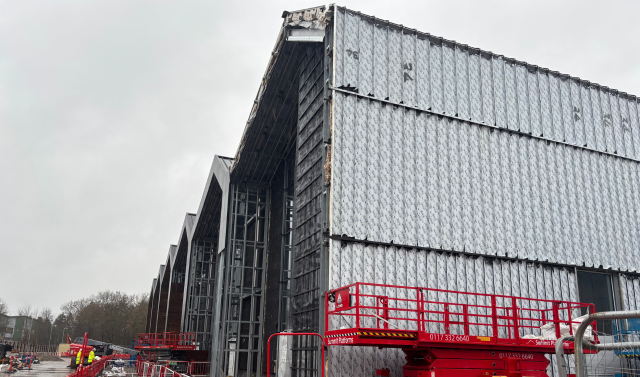
The creation of Tech Edge West by main contractor Glencar on the campus, located near Didcot in Oxfordshire, will provide 70,000 sq. ft of mixed-use office space to support a growing community of scientists, engineers and innovators within the Oxford-Cambridge Arc. Occupying a site on the north-western corner of Harwell campus adjacent to Phase One of the development, Tech Edge 1 & 2, the speculatively designed building will accommodate multi-tenancy and meet a variety of spatial requirements both now and in the future.
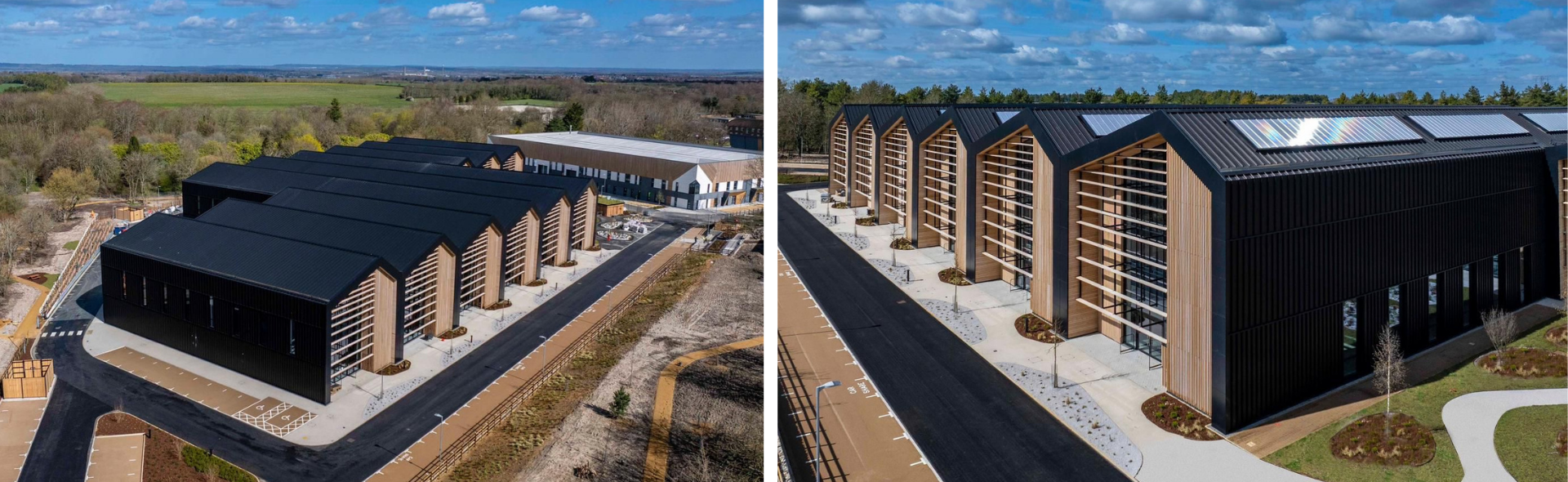
Designed by architects Scott Brownrigg to meet Carbon Net Zero in construction and target BREEAM Very Good certification, the new development’s design follows a fabric-first approach. It uses modulated brise soleil on south-facing glazed facades and polycarbonate on north-facing facades to optimise natural light, manage solar gain and minimise artificial light spill to the surrounding environment, plus photovoltaic (PV) panels installed onto southwest-facing sections of the roof.
Contemporary sawtooth roof with recessed facade design
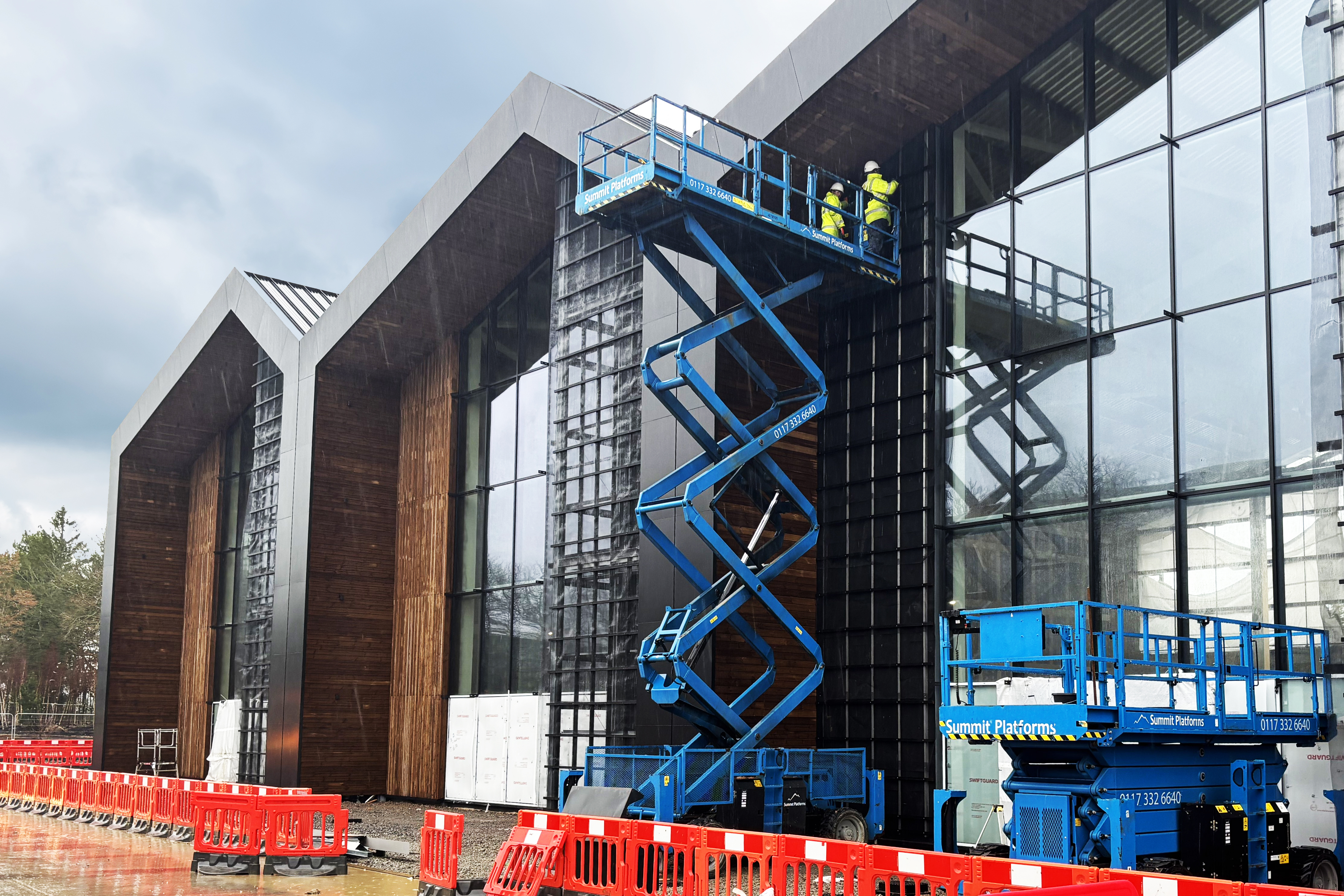
The building’s eye-catching design features a sawtooth roof, which seeks to ‘unify and define’ the nine individual mid-tech units, each benefiting from a private entrance and views out across extensive landscaping to the south of the site. The building envelope utilises a carefully considered palette of materials, with dark standing seam roofs and outer walls combined with naturally finished timber cladding to complement the natural setting and enhance the building’s striking architectural form. Each unit features a recessed façade at the gable ends formed through incorporating cantilevered purlins into the roof design. This allows for curtain walling to be incorporated, maximising internal light, with the overhanging roof helping to manage solar gain.
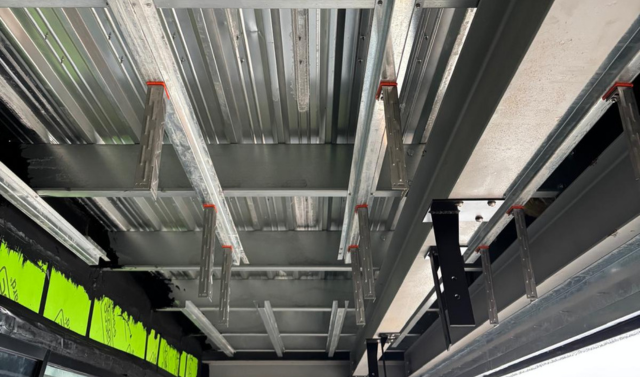
This element of the design required a continuation of the exterior wall’s Thermopine timber cladding on the soffit of the roof overhang to achieve the aesthetic goal. And it was here where EJOT UK were tasked by the project’s building envelope contractor, Kovara Projects, with providing a ‘plug-and-play’ solution for this distinctive architectural feature, which covers a total of 24 sq. m across the eaves of all the recessed facades, using the CROSSFIX system.
Unlocking the potential of CROSSFIX’s versatility
EJOT CROSSFIX is an advanced, stainless steel (A4) substructure system designed for mounting rainscreen facades and bespoke cladding, offering sustainability and thermal efficiency advantages over aluminium alternatives. Robust and supported with both a European Technical Assessment (ETA) and an Environmental Product Declaration (EPD), the system is uniquely versatile in that it enables both horizontal and vertical support profiles to be attached to a single console (bracket) to streamline the installation process.Kovara Projects initially considered the option of engineering their own rail and bracket solution. However, given the additional time this would have added to undertake engineering calculations and arrange fabrication, the team were attracted to the significant advantages offered by the off-the-shelf solution CROSSFIX offered.
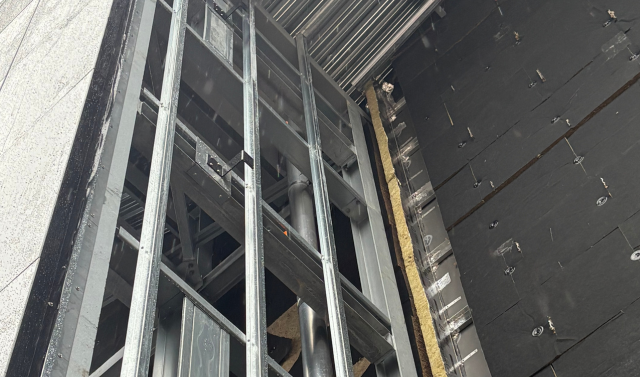
Scott Norris, Kovara Projects’ Design Director, had been introduced to the CROSSFIX system in discussions about other façade projects by EJOT UK’s Flat Roofing Business Development Manager, Kevin Rackley, and he was keen to explore how it could be utilised in bespoke scenarios like Tech Edge West, as well as more standard rainscreen projects. It required a fixing solution that suitably achieved distancing from the main purlin whilst also ensuring a seamless continuation of the timber façade cladding up to a ridge height of 15m.
Rapid turnaround from calcs to site delivery
The first steps in developing the required solution involved EJOT UK’s Technical Manager, Jon Knaggs, liaising with Kovara’s design team and utilising CROSSFIX’s integral engineering calculation program – an integral part of the CROSSFIX design solution. This ensured a specification including the full engineering calculations could be provided quickly to avoid delays.This capability, coupled with the flexibility of the system, impressed Scott Norris and the Kovara team. Scott said: “By utilising the CROSSFIX system in conjunction with EJOT’s technical support, the system’s enhanced structural and spanning capabilities were identified and incorporated into the design, enabling a reduction in the quantity of material required for the soffit installation when compared with a traditional bespoke fabricated support framework. This was achieved while maintaining a fully engineered, structurally robust solution and reducing the practical and ergonomic challenges associated with overhead installation works.”
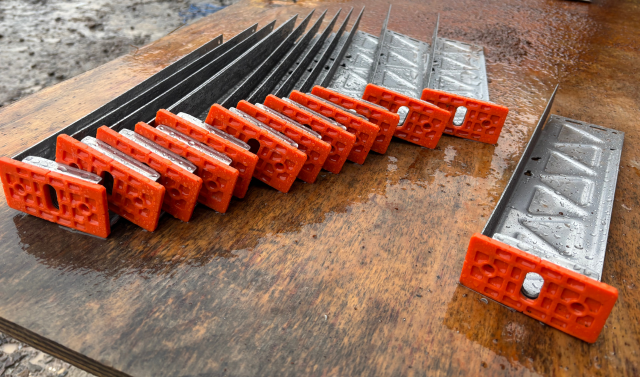
The package developed for the Harwell project included EJOT CROSSFIX KONSOLE K1 – an A2 (Grade 304) stainless steel bracket – complete with Thermostop, used in conjunction with EJOT CROSSFIX L-Profil profiles, also manufactured in stainless steel. Sixty brackets and profiles were required for each of the twelve soffit areas.
The CROSSFIX KONSOLE was attached to the L-shaped profiles using JT9-2/5-5.0 x 25 Vario screws and JT3-3-6.3 x 38. The Vario screw is purpose-designed for this application with a buffer zone between the screw head and sliding washer that helps to prevent excessive clamp load of the joint, whilst allowing the connection to move smoothly when the supporting profile expands and contracts.
Once the substructure design and product specification were approved by Kovara and the wider project team, EJOT supplied the complete CROSSFIX package to site with a comprehensive installation guide. This proved to be a genuine time-saver on site, according to Kovara’s Projects
Manager, Craig Smith, who commented: “The CROSSFIX detailing allowed us to easily generate installation guidance for our site team to follow. With such a niche and unusually deep fixing application, the value of working to an easy step-by-step process to fix the sub-grid, whilst maintaining full structural integrity, proved to be invaluable for our installers.”
EJOT UK’s Kevin Rackley added: “We were delighted to be able to support Kovara Projects on this landmark scheme and enable the architect’s aesthetic vision for the timber cladding to be achieved without compromise.
“The versatility offered by CROSSFIX due to the nature of its design means it can solve all kinds of façade fixing challenges without the need to develop bespoke bracket and support profiles. In addition to the cost and time savings this offers, this also provides the assurance of an ETA to demonstrate its performance capabilities.”