How are bi-metallic self-drilling fasteners made?
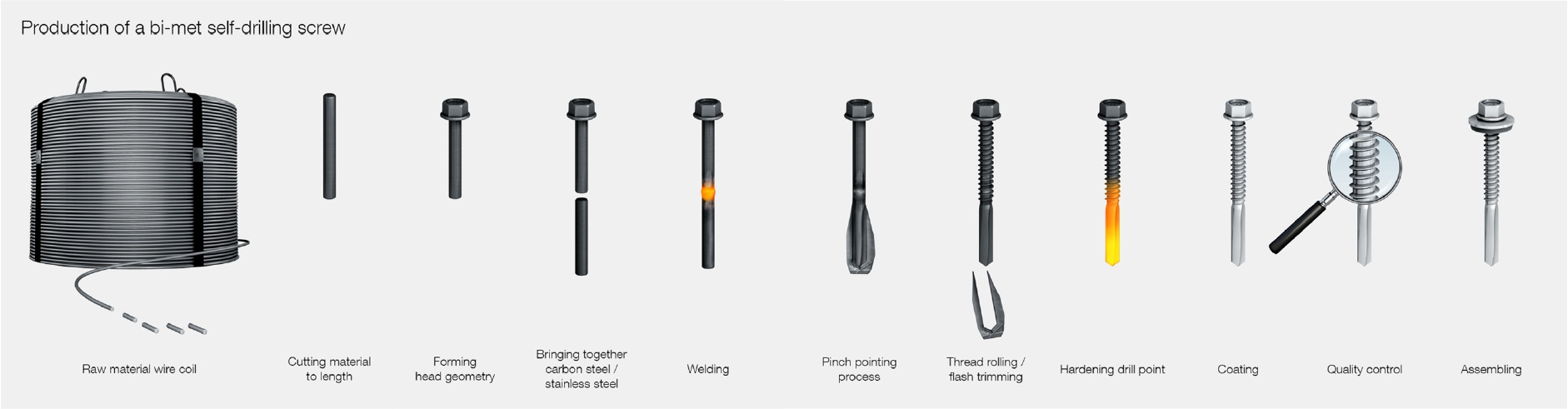
The production phases of a bi-met self-drilling screw using the example of the JT3-18-5.5
Starting Material: Steel & Stainless-Steel Wire
At the beginning of the screw production, the starting material has the form of wire. This means the heat-treated steel or stainless steel, which is delivered coiled, hence the name coil. First, the wire is cut to the correct length and shaped in this stage as well. This process takes place in several forming stages, depending on the head geometry.Bimetal Construction: Combining Two Materials
The upper part of the bi-met self-drilling screw consists of stainless steel, so that it offers an ideal corrosion protection and can be used in weather-exposed areas. The lower part, where the drill point is manufactured later on, is made of carbon steel. The advantage of this material compared to stainless steel is that it can be hardened and is thus able to penetrate steel structures without any difficulty.Welding Process: Joining Upper & Lower Components
In the next production step, the two parts are welded together. The welding process creates the unique material combination of the bi-met self-drilling screws from the corrosion-resistant upper part made of stainless steel and a hardened drill point.Pinch Pointing: Forming the Drill Tip
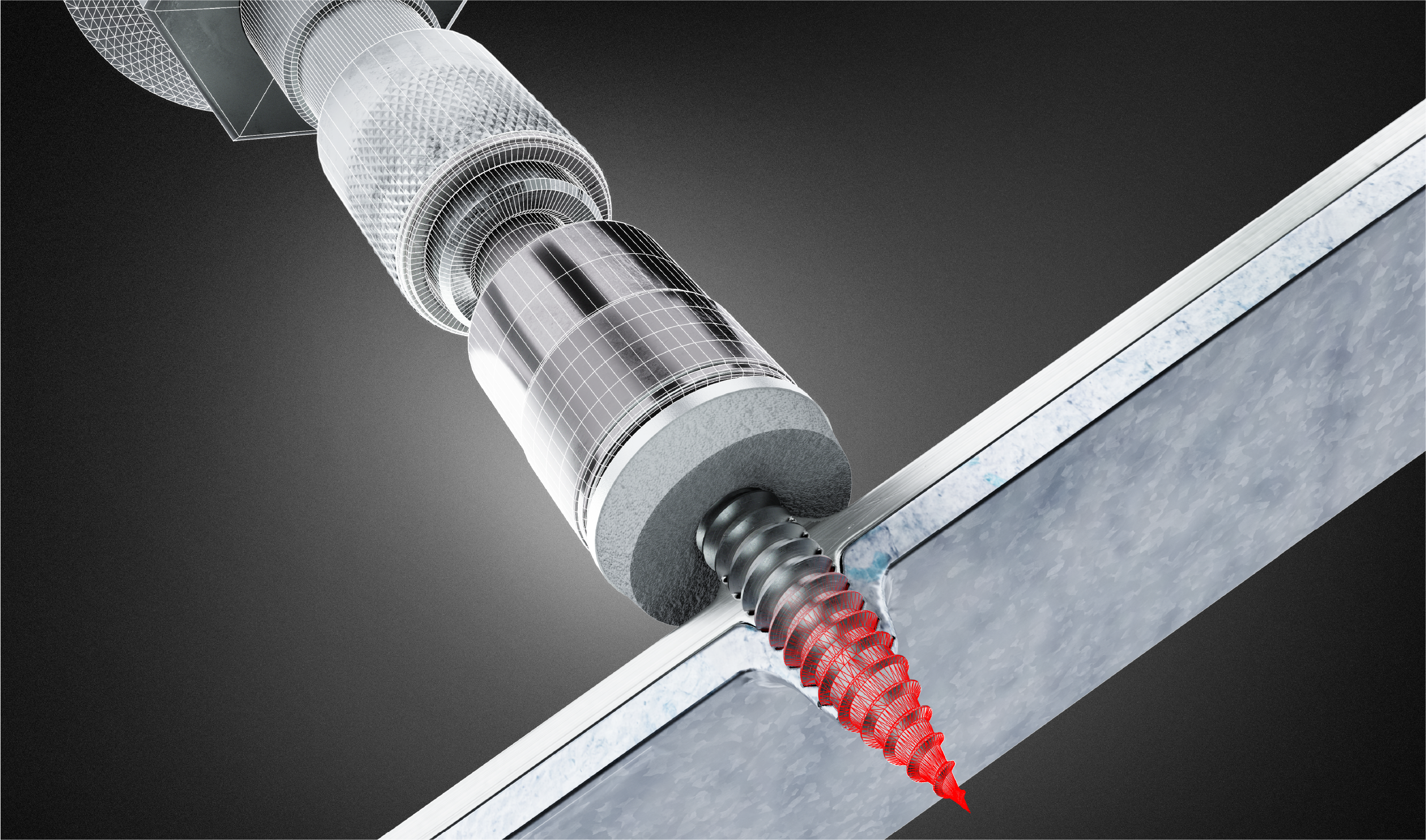
The next step is pinch-pointing. This is a so-called closed-die forging process that is a type of massive forming process. The typical drill point is formed from the screw blank. After pinch pointing, the next steps are thread-rolling and the removal of slugs, whereby the screw thread is formed on the screw blank. This step represents the last work step for changing the geometry.Thread Rolling & Slug Removal
In the following hardening process, the bi-met screws are partially hardened. What makes it special: only the area of the drill point is heated and then quenched in a water bath. This gives the drill point the hardness it needs to penetrate up to 18 mm of construction steel. At the same time, the stainless-steel upper part maintains its high corrosion resistance.Hardening the Drill Point for Performance
The screws are then electroplated and lubricated. The coating serves two purposes: on the one hand, it protects the drill point from corrosion, and, on the other hand, this layer structure improves the assembly properties of the self-drilling screw.Surface Finishing: Electroplating & Lubrication
Quality controls take place over and over again during the entire manufacturing process. The drilling test is one example of quality control. The screw must drill through a steel test plate but must not exceed a predefined time. Since cooling lubricants are used again and again during production, the screws are cleaned in special washing systems after the individual work steps.Quality Control & Drilling Tests
Once our starting material has passed through all the production steps of the cold forming process, the end result, completed with a sealing washer, is a finished EJOT self-drilling screw in the quality as you know it.In this article, we have briefly presented the various methods for producing screws. In practice, thread-cutting has established itself as the most common process, not least because of the better mechanical properties of the end product and the possibility of producing very large quantities per unit of time. In the next part of the self-drilling screw guide, we look at the subject of edge distances and explain what needs to be considered with regard to the various substructures.