Common mistakes when installing self-drilling fasteners & how to avoid them
The current part of the self-drilling screw guide is now devoted to avoiding damages that can occur due to improper assembly.
Purpose of Sealing Washers
Sealing washers are always used in construction when a screw connection is to be protected against the penetration of moisture and dirt or to distribute the existing clamp loads over a larger area than that of the screw head.The clamp load and thus the tensile stress in the screw are limited by the use of sealing washers. Direct outdoor exposure of the fastening point is virtually prevented - the risk of an operational, hydrogen-induced embrittlement (you can find an interesting article on this topic here) is significantly reduced. The risk of incorrect assembly (including excessive tightening torque or slightly inclined tensioning) with a screw connection is significantly reduced by using sealing washers.
Installation Requirements: Depth Control
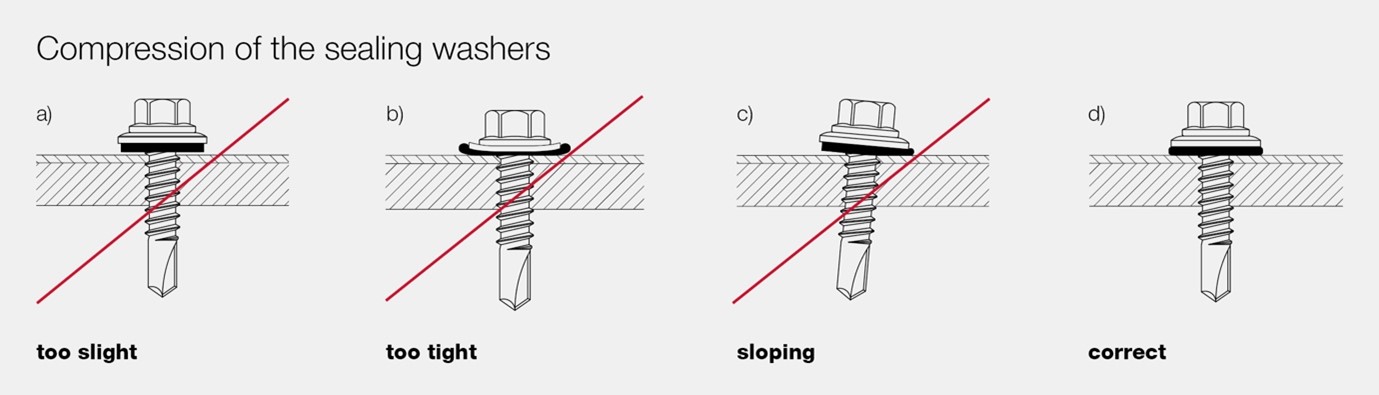
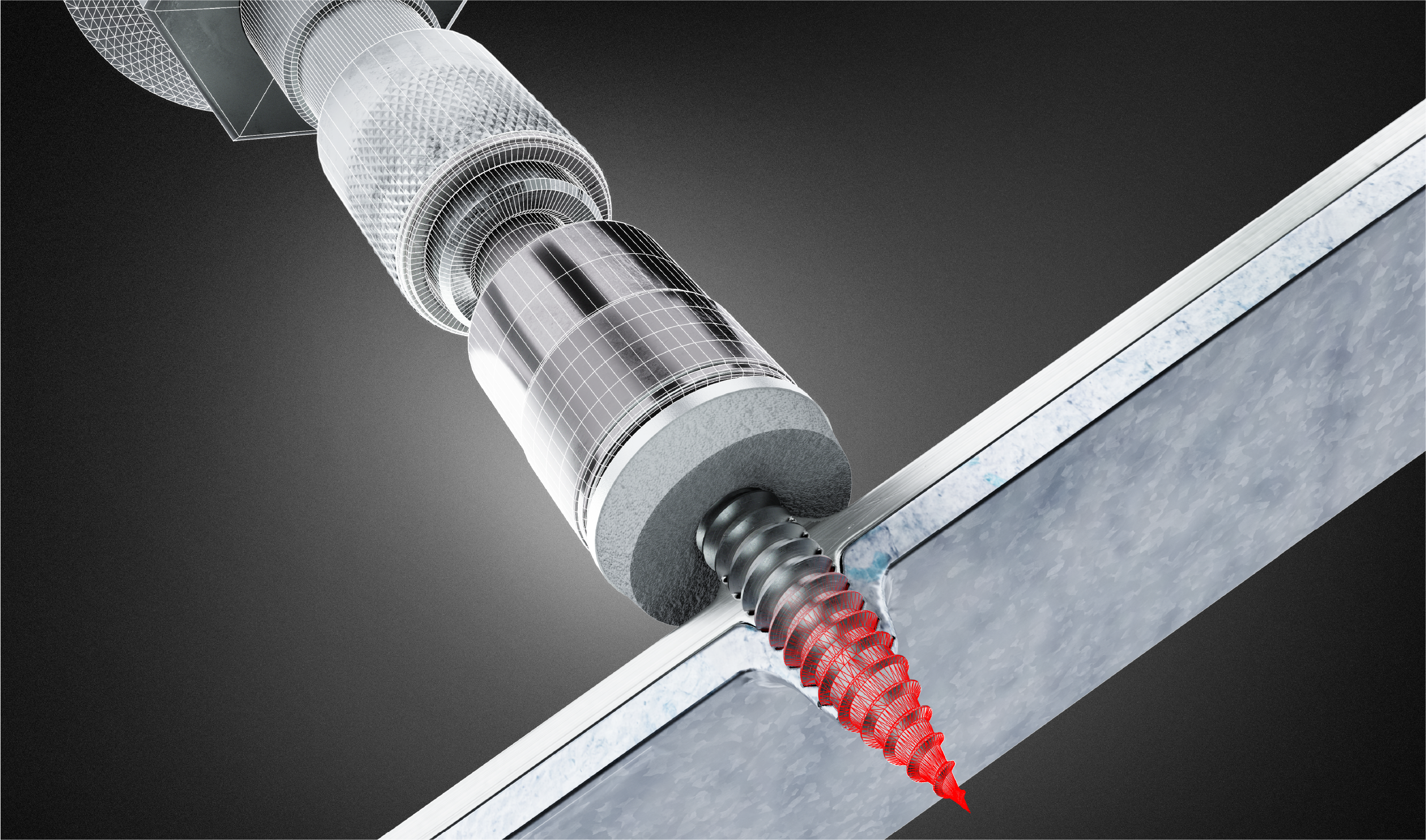
Screws with sealing washers must be installed using depth control. The depth stop can be set by using a suitable drill and inadmissible deformation of the sealing washer (washer with elastomer seal) can be prevented.Consequences of Incorrect Tightening
If the screw with the sealing washer has not been tightened enough, it is too loose (a) and tightness cannot be guaranteed. On the other hand, if it is tightened too much, the sealing washer bulges out (b) and the inner lip seal (EPDM) can be damaged. Tightness cannot be guaranteed either.Importance of Straight Screw Alignment
Care must also be taken to ensure that the screw connection is straight. An inclined screw connection (c) cannot provide the desired tightness either. If the sealing washer is correctly installed, the sealing rubber may protrude from the side (d). The joint is definitely too tight only if the metal back of the sealing washer changes from convex to concave.