
Flat Roofing Guidebook Banner Image - 1920 x 590.png

What Is the Difference Between a Flat Roof and a Pitched Roof?


In general a distinction is made between roofs with roof covering (pitched roofs) and roofs with roof sealing (flat roofs).
 
In the case of roof covering, the roof skin consists of individual components such as roof stones, roof tiles, small-format shingle-shaped components or large-format panel-shaped components. They are not waterproof, they just drain the water away. They are therefore called impervious to rain. The minimum roof pitch of roofs with roof covering is known as the standard roof pitch and ultimately depends on the materials used. Roofing can be made of different materials, such as concrete, brick, wood, straw or metal.
 
On roofs with waterproofing, the roofing membrane is seamlessly sealed with strip-shaped materials. This is normally done on roofs with a low slope. Although there is no clear information about the slopes of flat roofs in the German Building Code, the Flat Roof Directive recommends a slope of at least two percent or 1.1 degrees. The optimum is five percent or 2.9 degrees. DIN 18531 "Roof waterproofing" classifies flat roofs into slope group I with a slope of up to three degrees and slope group II with a slope of three to five degrees.
Flat Roofing Expert 3 Teaser Image - 640 x 377.png.jpg

How Is a Flat Roof Constructed?


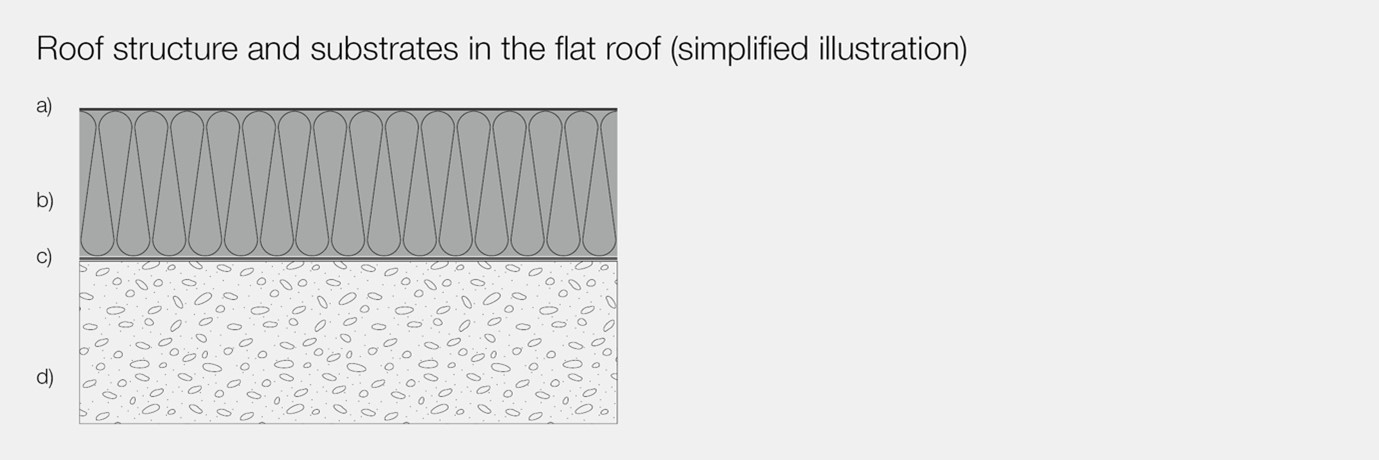
A conventional flat roof structure is made up of the following:



Waterproofing Membrane Layers in Flat Roof Systems

The upper layer is the waterproof layer. It normally consists of a single-layer plastic or bitumen membrane (a). A wide variety of materials, such as PVC, TPO, FPO or EVA, can be used in a plastic roof membrane. They usually have an internal thread to ensure the mechanical characteristics. With bitumen membranes, multi-layer systems are also possible.​​


Flat Roof Insulation Materials and Thermal Performance

The second layer is, optionally and depending on the use and the fire prevention requirements, a heat insulation layer (b). Conventional insulating materials on flat roofs are PIR, PUR, EPS or mineral wool. The thickness of the insulating materials varies from 20 mm to 600 mm, for example, in cold stores.


Vapour Control Layers and Moisture Protection

A vapour barrier layer (c) is installed between the substrate, the so-called load-carrying layer (d), and the thermal insulation layer. This can also be made of diverse materials.


Load-Bearing Roof Decks and Structural Substrates

The basis for a flat roof is the load-carrying layer. In Germany, 80% of load-carrying layers are made of trapezoidal sheet steel. The trapezoidal load-bearing shells normally have a thickness of 0.75 - 0.88 mm. Other substrates can, however, be made of wood or wood-based materials, concrete, lightweight concrete and aerated concrete. The substrates vary internationally and regionally. For example, the share of load-bearing layers made of concrete is much higher in southern European countries such as Italy and Spain.
Kev-Rackley.png

Talk to our Flat Roofing Business Development Manager

EJOT UK provides highly specialised support for flat roofing applications. If you have any questions, please contact Kevin Rackley. Kevin can update you on all new product applications and offer technical support.

M: 07720 883827
E: KRackley@ejot.com


Flat Roofing Expert Content Teaser Image - 640 x 377.png

View all Flat Roofing Products

EJOT UK offers a range of flat roofing products, including the following:


Webshop Image - 640 x 377.png

Buy Online & Save Time

Our webshop has expanded to over 3,000 fastening products available online. Registration is straightforward and creates a personalised online pricing structure, flexible purchasing and a history of previous orders.


Register Here