

Typical Failure Results During Wind Uplift Testing
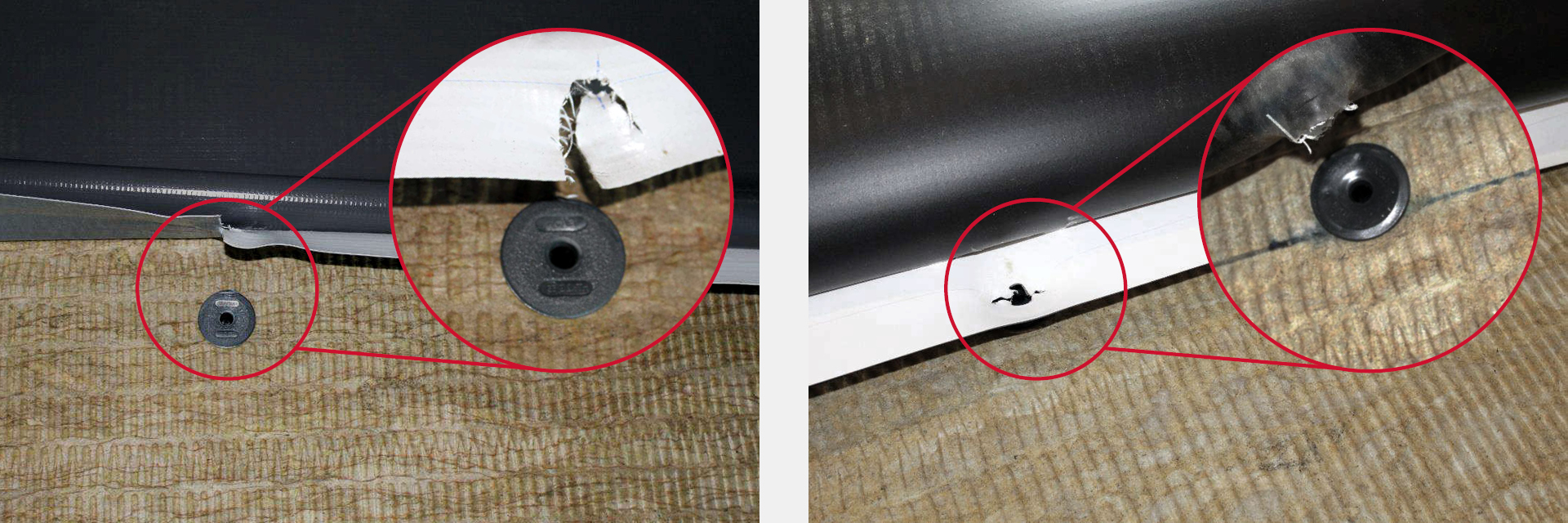
The usual failure pattern of a wind uplift test is tearing (left picture) or pulling over the roofing membrane (right picture). They account for around 90% of all failure cases in a wind uplift test.
Fastener Pull-Out Failures During Wind Uplift Tests
Another, albeit rare, failure is the fastener being pulled out of the substrate. The frequency of this failure is around 8 per cent. It mainly occurs with enormously strong roofing membranes and is the normal failure with linear rail fixing systems.
Weld Seam and Roofing Membrane Processing Failures
Exceedingly rare, but also possible, is the roofing membrane being pulled out behind the welded seam. Normally this is due to a processing error when welding the roofing membrane, or a material error in the fabric inserted into the roofing membrane.
What Information Is Included Within a Wind Uplift Test Report?
Following a wind uplift test, the client receives a test report. This test report firstly describes the system set-up, including all the individual components, and the results are determined with the aid of correction factors and partial safety factors. Afterwards, the test set-up is described using images, and the failure is documented.
How Wind Uplift Test Results Are Used in Wind Load Calculations
The rated value of the load-bearing capacity resulting from the test report – this can be reduced again to a certain value depending on a manufacturer's ETA system – is then included in the wind load calculation. We will deal with the wind load calculation according to DIN EN 1991-1-4 in the next part of our guidebook.