

Wind Zones and Terrain Roughness in Flat Roof Wind Calculations
First of all, the wind zone is crucial. Germany is divided into four wind zones and differs significantly from central Germany to the coastal area. The wind zones are defined in the national annex of DIN EN 1991-1-4.
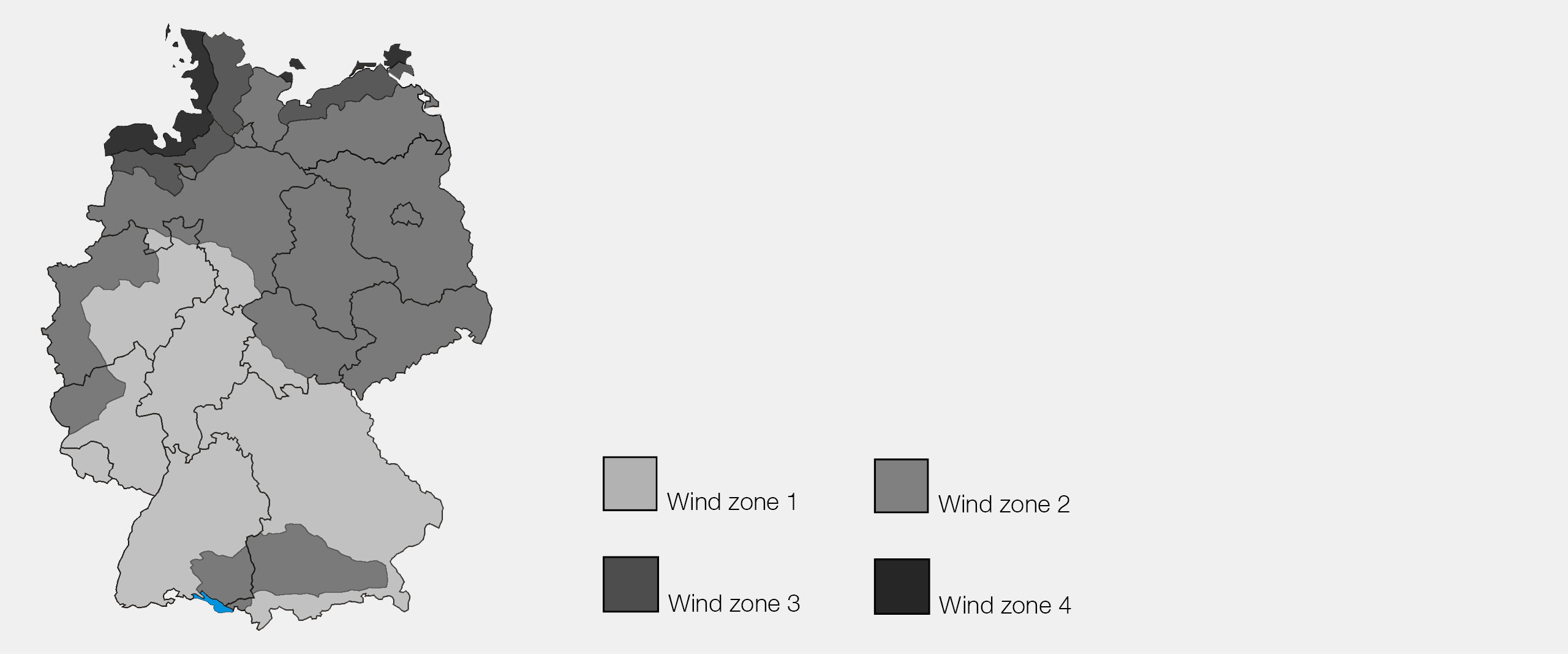
How Building Location Determines Wind Zone Classification
The geographical location of the building determines the applicable wind zone. A list published and regularly updated at the DIBt (German Institute for Building Technology) contains an allocation of the wind zones according to administrative boundaries and is clearly assigned on the basis of the municipality code number.
Terrain Categories Used in Wind Load Assessments
Furthermore, it must be specified which terrain roughness exists at the building's location. Four terrain categories are defined:
- Terrain Category GK I - Open Coastal and Flat Landscapes: open sea, lakes with at least 5 km of open space in the direction of the wind; smooth flat land without obstacles
- Terrain Category GK II - Rural Areas and Individual Buildings: terrain with hedges, individual farmsteads, houses
- Terrain Category GK III - Industrial and Suburban Areas: suburbs, industrial or commercial areas
- Terrain Category GK IV - Dense Urban Environments: urban areas where at least 15 % of the area is covered with buildings whose average height exceeds 15 m.
How Gust Velocity Pressure Is Determined
The German national annex of DIN EN 1991-1-4 shows a way to determine the gust velocity pressure using control profiles. Control profiles are inland, coastal areas, as well as islands of the Baltic Sea and as a third profile, the islands of the North Sea. This classification is extremely popular.